Monday, 9 September 2019

Visa!!!


When Jenny received her residence visa on her birthday I asked Musa, our AVI in-country manager, if I could have mine for my birthday.  Last Monday he sent me an email to say that my visa had been approved - a bit early but I'm not complaining.  So now Jenny can stay until the end of July 2021 and I can stay until the end of August 2021.  Our jobs finish in October 2020 so we have some thinking to do about what happens then.  Do we just pack up and go home or do we use the remaining 9 months or so to travel to interesting places in Africa and beyond?  From Kilimanjaro airport we can get to the Middle East, Europe and several countries in Africa quite easily and cheaply.  We could keep our car and house until the visas expire.  The best things in the short term are no more immigration stress and half price entry into the national parks!

A major milestone last week at work with the submission of a big project proposal to the Nordic Climate Fund.  If successful this will keep ECHO staff busily and usefully employed for three years and will see some really exciting work done in villages on the slopes of Mount Meru and nearby Monduli.  No I turn my attention to two new project proposals while we await the decisions on the two earlier ones.

With the weather warming up we threw off one of our blankets recently.  Never before have we slept regularly in Africa with one blanket let alone two.  We have been watching the storm clouds brewing to our north and west but still no rain here.  The Serengeti plains had heavy rain a week or so back.  It is probably not coming until November but we can hope for an early wet season.

To celebrate our new status in the country Jenny bought four new plastic chairs to go with a table we already had.  These are installed in the back garden and we had a lovely day on Saturday out there with books, the footy, the cricket and some nice birds.


The wifi reaches too!
This Red-chested Cuckoo sat on this branch in the garden for about five hours and didn't call once.

Pachnoda ephippiata (Fruit Chafer) is a large scarab beetle that is quite common in our garden.
This one has its head down.

On Sunday we were up early for a birding morning at Kilimanjaro Golf Estate south of Usa River.  We were late - first the guard couldn't undo the padlock to open the gate to let us out.  We had to go out another, rarely used gate that took some opening as well.  Then of course we got lost on the estate looking for our rendezvous point.  Eventually we met up with four of the Attraction Birding Club crew and we spent five hours wandering the course and adjacent bush.  We only saw one couple playing golf so you never have to worry about errant golf balls.  The birds list was 85 species with four lifers for me. Two were lifers for everyone - Alpine Swift and Pallid Honeyguide.  The others for me were Red-fronted Tinkerbird and Bare-eyed Thrush.


Purple Grenadier
Mid-sized Leopard Tortoise hiding from Jenny
Bare-eyed Thrush
Nubian Woodpecker (female)
White-browed Scrub-Robin
Spectacled Weaver
African Grey Flycatcher
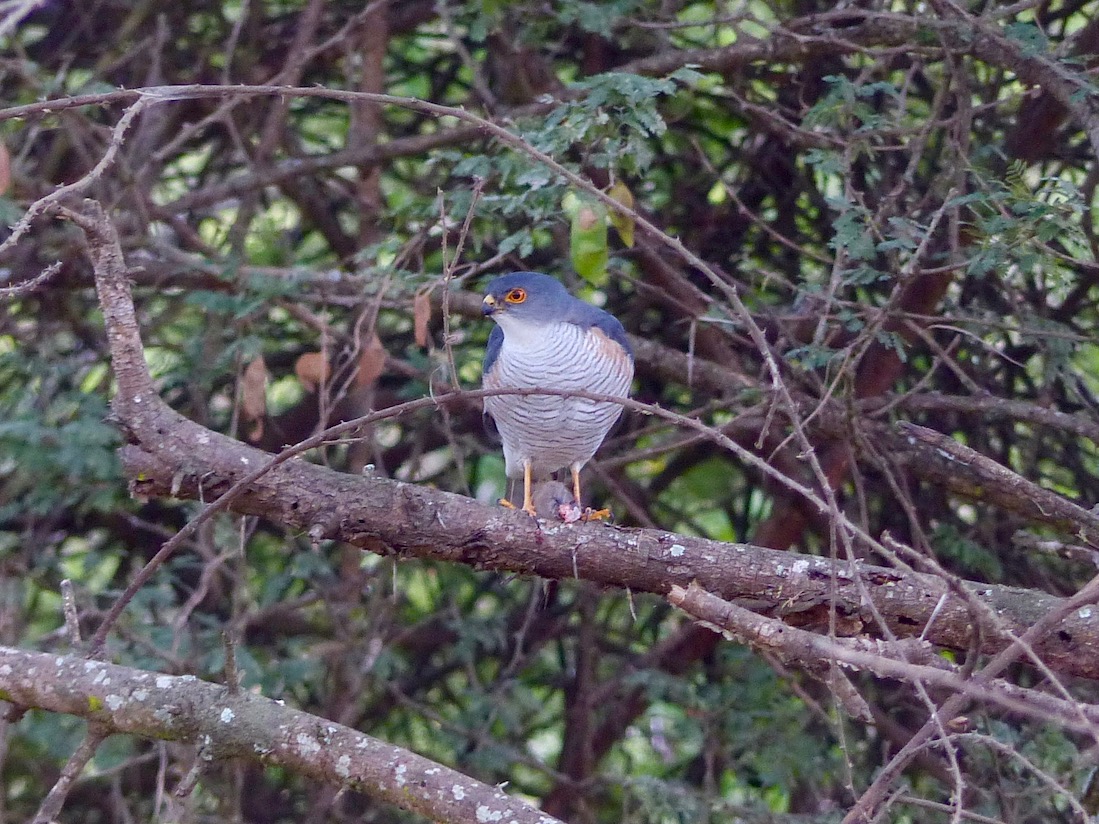
Little Sparrowhawk and brunch
Hildebrandt's Starling
African Yellow Warbler

Sunday, 1 September 2019

An Agricultural Fair and some birding

With Jenny away for a few days I had a very quiet last weekend at home - mostly keeping an eye on the African Goshawk nest to see if I could detect chicks.  Still not sure!

Last Friday I went with ECHO colleagues to Karatu (-3.3398, 35.6682) for an Agricultural Fair (seed and food were the main themes).  About a dozen NGOs were showing their skills and services and there were lots of speeches, music and noise.  Everyone chipped in so there was no cost to the public and we probably had 500 people come through on the day.  My favourite thing was a chap who had a team building game where you had to cooperate with your colleagues to move assorted blocks onto a stack.  Lots of laughter.
Assorted herbs that can cure anything from a cold to cancer and HIV (apparently).


I've never seen this before but lots of fun.

Phillip (a semi-retired tractor engineer from Canada) and Harold Msanya (Echo's chief designer of low-tech farm equipment) discussing improvements.
ECHO has taken a tried and tested Ethiopian plough and added a seed/fertiliser sewing system.

Yesterday I went birding with our friends from the Birding for Life group and Alex Rees (an English chap with great bird photography skills).

Alex took the photo.
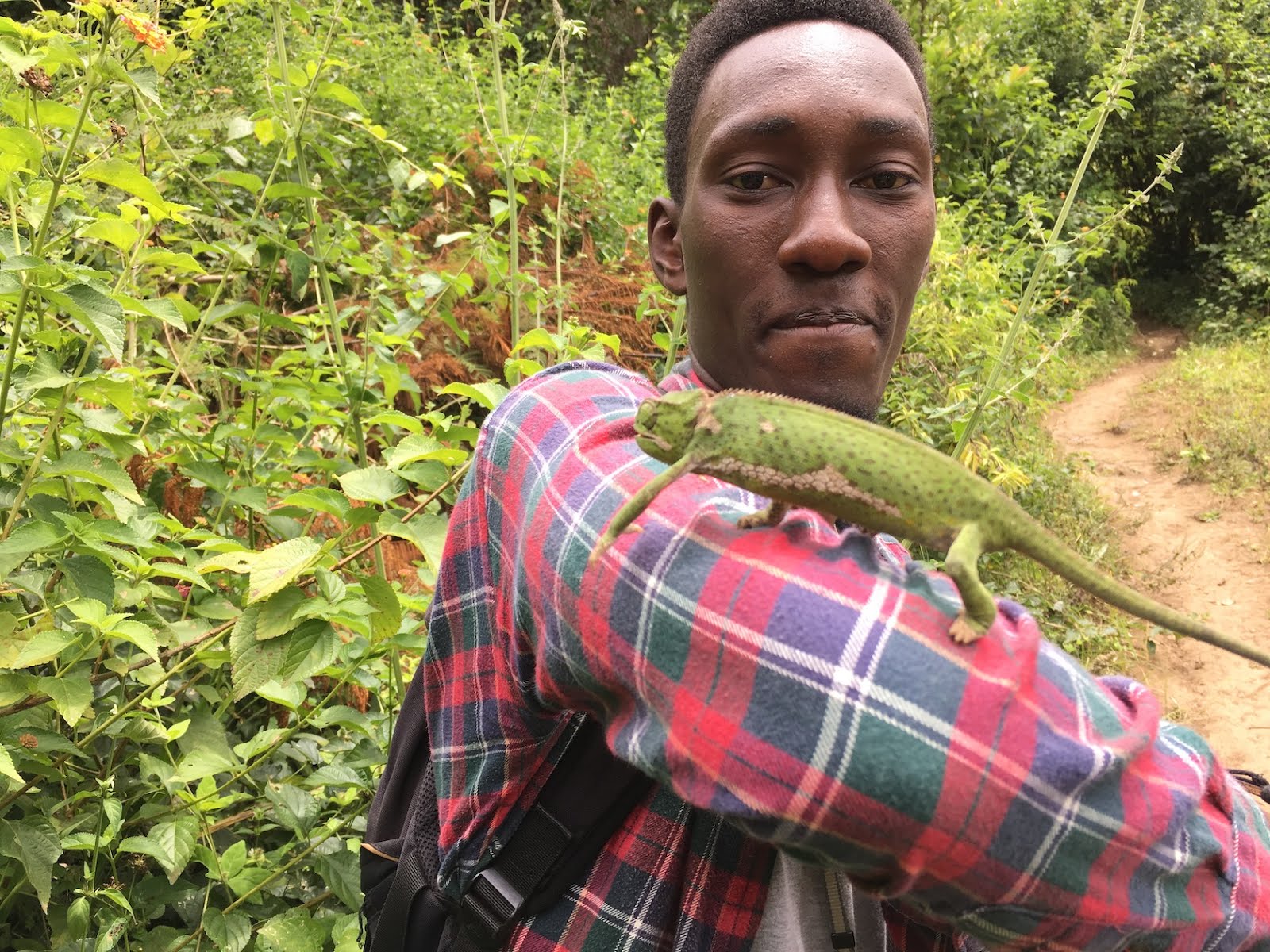
We went to an area called Danish Forest up above Usa River.  Mostly forest trees along streams coming off Mount Meru with some village farm areas.   We saw about 50 species in all and I saw Green Malkoha (aka Eastern Yellowbird) and Retz's Helmetshrike as lifers plus Mountain Wagtail and Black-throated Wattle-eye as new for Tanzania.  I left my camera in the bag as it was drizzly and overcast and I didn't think I would have much success.    I did take a picture of our group on the trail and a large Flap-necked Chameleon on the arm of Joseph Sikawa.

On a trail through towering remnant forest trees.

Flap-necked Chameleon - one of the biggest species in East Africa.

Wednesday, 21 August 2019

Happy birthday Jenny, a weekend glamping and visiting Lake Manyara National Park

With Jenny's birthday on Monday we booked into Africa Safari Glamping tented camp (-3.39396, 35.87662) near Mto Wa Mbu (Mosquito River) for the Saturday and Sunday nights leading up to it.  It's a new camp with a range of tents from basic to very nice.  We chose very nice.  It is situated in a dense stand of enormous Fever Trees.  Click here for info and photos.  Jenny enjoyed the pool and I was happy walking the grounds watching birds.  Each evening we had Slender-tailed Nightjars swooping around our tent - a new bird for me.

This fellow (and a rather large Cape Buffalo) kept us stuck in one spot for quite a while.  He only moved when the safari car came.  We were very aware how small our RAV4 is.
Immature Martial Eagle (photo by Jenny)
A pair of Hildebrandt's Francolin (female in front).
Banded Mongoose - always fun to watch Mongoose.
On Sunday we we up early and through the gate into Lake Manyara NP.  We drove purposefully the 33 km down to the Hot Springs board walk (-3.61759, 35.73864) and then more slowly back taking side loop tracks as we felt inclined.  The park was very busy and we had to wait behind safari cars on several occasions while their clients snapped photos of whatever with their camera phones.  A word of advice - if you are going to come all this way and spend a large sum of money on safaris - buy a decent camera and learn how to use it.

About 25 Safari vehicles at the Hot Springs picnic site with another dozen or so parked along the road out of shot.  Our  RAV4 is in there somewhere.
Yellow-billed Storks and some of the 480 African Spoonbills I counted at the springs.
A magnificent Saddle-billed Stork (this photo is not cropped!). Photo by Jenny.
Zebra in front of hundreds of Great White Pelicans with Lesser Flamingos further out.
Birds in the bush and at the lake were abundant.  I counted 480 African Spoonbills at the Hot Springs alone.  We also saw about 50 Silvery-cheeked Hornbills in a small area of forest where there must have been fruiting trees.  All up we saw 104 birds species plus many mammals.  A great day!

Long-toed Lapwing
Kittlitz's Plover chick
Hippos at Hippo Pool (with a couple of African Jacana)
Wood Sandpiper just arrived from northern Europe.
A birthday highlight for Jenny was her residence visa arriving on Monday.  She can stay until July 2021.  Now I just need mine!  My current tourist visa expires on October 1st - not far off.

Purple Heron
Egyptian Goose - often neglected because they are common but beautiful birds.
African Swamphen
We are planning the future months assuming my permits come through.  We have assorted friends arriving for various reasons (volunteering, studying, tourism) from now until January at least.  In some cases we will catch up with them for a few hours. In other cases we will join them on safari.  Life is good!


Tuesday, 13 August 2019

Arusha National Park visit


Lesser Flamingos - Jenny thought this would make a good jigsaw.
Arusha National Park is often left off the itinerary of visitors to Tanzania's National Parks.  Other parks have lions, cheetahs, rhinoceros, wildebeest, crocodiles.  Kilimanjaro has a higher mountain.  Arusha has small areas of open grassland, large areas of wetlands, woodland and forest and a huge dormant volcano looming over all.  It has a selection of large mammals - elephants, giraffe, buffalo, zebra, assorted antelope but mostly it has birds.  With 550 species recorded it has more than Tarangire and only a few less than Serengeti.  I have now seen 141 species in 5 visits - plenty of work to do still.

Hard not to photograph Little Bee-eaters.
A Rufous-naped Lark singing away (The have rufous napes in other parts of Africa!)
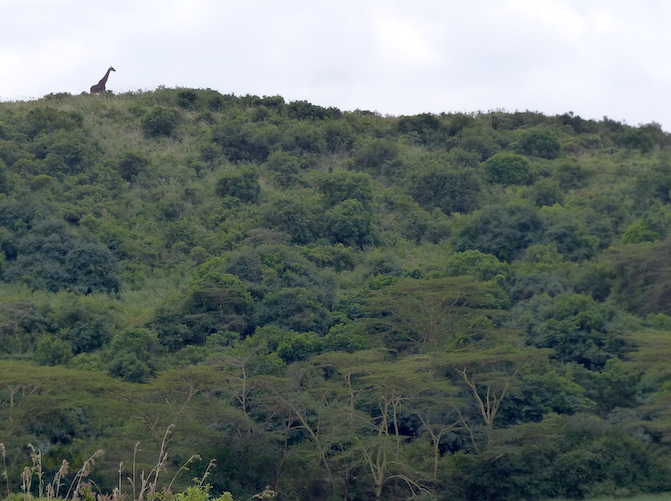
A Giraffe posing nicely.
It is a small park and you can drive most of it in a day.  Yesterday we decided to take a track we have avoided on previous visits in an effort to get up high.  Mostly we keep below 1600 m but there are a dozen or so bird species that only occur above about 2000 m so after a drive to the Momela Lakes we climbed to about 2200 m to a picnic ground.  The road kept going up but some people driving down said it deteriorated badly from that point on.  We possibly would have walked further up but earlier we had seen several buffalo way higher than we thought they would be.  Birding along the road and at the picnic ground produced some lifers - Abyssinian Thrush, Bar-tailed Trogon and Brown Woodland-Warbler along with other forest specialists such as Mountain Buzzard, Kenrick's Starling, Hartlaub's Turaco and Mountain Greenbul.

White-eyed Slaty Flycatcher
Brown-hooded Kingfisher
Otherwise we had a great day in the park.  It was quite busy with family groups enjoying the holiday and safari vehicles with foreign tourists but apart from a few places it was easy to get away from them all.
Giant Fig - according to the signboard you can drive an elephant-sized car through it.
Maio Waterfall above 2000 m.
Ancient Podocarps at Maio Waterfall.
Another highlight was a flock of 22 Maccoa Ducks on Small Momela Lake.  This is a close relative of the Australian Blue-billed Duck and is becoming increasingly rare.  Arusha NP is one of the few places it can be seen in any numbers - formerly in 1000s now not more than 100 at a time.

Maccoa Ducks (stiff, erect tails at the back) with Southern Pochard (at the front).


Sunday, 11 August 2019

Snow and birdng at Kili Golf.

We woke last Saturday to light drizzle and when the skies cleared in the afternoon our mountain had a light dusting of snow.  It lasted through to Sunday.

Zooming in on the snow.
On Thursday (a public holiday) we went with our local birding friends James and Isaac to Kilimanjaro Golf Estate for a few hours of birding.  We met Englishman Alex Rees who lives nearby and he showed us a pond where we found at least six Greater Painted-snipe.  This species is probably not rare but is seldom seen because it usually hides in dense vegetation during the day and is active at night.  Unusually, the females take the dominant role and the males do all the incubating and chick rearing.  We suspect that breeding is about to begin because we saw some aggression between two females.

Sparring female Greater Painted-snipe
Alex had to leave us but we, plus two other late comers spent the next several hours wandering the acacia woodland and wetlands between the fairways.  We saw 74 species in all.  The Painted-snipe, Black-faced Waxbill and African Black Swift were all new for me in Tanzania.  Other highlights included Mourning Collared Dove, Namaqua Dove, Green Sandpiper, Pearl-spotted Owlet, African Hoopoe, Green Wood Hoopoe, Giant Kingfisher, Orange-breasted Bushshrike, Slate-coloured Boubou, Brubru, Black Cuckooshrike, Sombre Greenbul, Violet-backed Starling and Southern Citril.


Greater Painted-snipe (female)

Magpie Shrike


Pearl-spotted Owlet
A young Leopard Tortoise (one of the 'Little Five' along with the Elephant Shrew, the Buffalo Weaver, the Rhinoceros Beetle and the Antlion)
Little Grebe
Green Sandpiper
Long-tailed Fiscal

At home recently we have had much activity at the two birdbaths in front of our house.  Yesterday we had Red-eyed Dove, Speckled Mousebird, Rüppell's Robin-Chat, Streaky Seed-eater, Pale White-eye, Dark-capped Bulbul, Red-backed Mannikin all visiting at the same time.

Arrow-marked Babbler
Baglafecht Weaver
Speckled Mousebird
Red-backed Mannikin
Our African Goshawk pair are still incubating.  Chicks should emerge in another 10 days or so and then we can watch the regular comings and goings as they are fed.  Last night we had a Verreaux's Eagle-Owl calling in the garden but I was not able to find it roosting this morning.

Off to Arusha National Park tomorrow for the day (public holiday for Eid El Haj) and next Saturday we go to a lodge near Lake Manyara for two days as Jenny's birthday treat.