Wednesday, 21 August 2019

Happy birthday Jenny, a weekend glamping and visiting Lake Manyara National Park

With Jenny's birthday on Monday we booked into Africa Safari Glamping tented camp (-3.39396, 35.87662) near Mto Wa Mbu (Mosquito River) for the Saturday and Sunday nights leading up to it.  It's a new camp with a range of tents from basic to very nice.  We chose very nice.  It is situated in a dense stand of enormous Fever Trees.  Click here for info and photos.  Jenny enjoyed the pool and I was happy walking the grounds watching birds.  Each evening we had Slender-tailed Nightjars swooping around our tent - a new bird for me.

This fellow (and a rather large Cape Buffalo) kept us stuck in one spot for quite a while.  He only moved when the safari car came.  We were very aware how small our RAV4 is.
Immature Martial Eagle (photo by Jenny)
A pair of Hildebrandt's Francolin (female in front).
Banded Mongoose - always fun to watch Mongoose.
On Sunday we we up early and through the gate into Lake Manyara NP.  We drove purposefully the 33 km down to the Hot Springs board walk (-3.61759, 35.73864) and then more slowly back taking side loop tracks as we felt inclined.  The park was very busy and we had to wait behind safari cars on several occasions while their clients snapped photos of whatever with their camera phones.  A word of advice - if you are going to come all this way and spend a large sum of money on safaris - buy a decent camera and learn how to use it.

About 25 Safari vehicles at the Hot Springs picnic site with another dozen or so parked along the road out of shot.  Our  RAV4 is in there somewhere.
Yellow-billed Storks and some of the 480 African Spoonbills I counted at the springs.
A magnificent Saddle-billed Stork (this photo is not cropped!). Photo by Jenny.
Zebra in front of hundreds of Great White Pelicans with Lesser Flamingos further out.
Birds in the bush and at the lake were abundant.  I counted 480 African Spoonbills at the Hot Springs alone.  We also saw about 50 Silvery-cheeked Hornbills in a small area of forest where there must have been fruiting trees.  All up we saw 104 birds species plus many mammals.  A great day!

Long-toed Lapwing
Kittlitz's Plover chick
Hippos at Hippo Pool (with a couple of African Jacana)
Wood Sandpiper just arrived from northern Europe.
A birthday highlight for Jenny was her residence visa arriving on Monday.  She can stay until July 2021.  Now I just need mine!  My current tourist visa expires on October 1st - not far off.

Purple Heron
Egyptian Goose - often neglected because they are common but beautiful birds.
African Swamphen
We are planning the future months assuming my permits come through.  We have assorted friends arriving for various reasons (volunteering, studying, tourism) from now until January at least.  In some cases we will catch up with them for a few hours. In other cases we will join them on safari.  Life is good!


Tuesday, 13 August 2019

Arusha National Park visit


Lesser Flamingos - Jenny thought this would make a good jigsaw.
Arusha National Park is often left off the itinerary of visitors to Tanzania's National Parks.  Other parks have lions, cheetahs, rhinoceros, wildebeest, crocodiles.  Kilimanjaro has a higher mountain.  Arusha has small areas of open grassland, large areas of wetlands, woodland and forest and a huge dormant volcano looming over all.  It has a selection of large mammals - elephants, giraffe, buffalo, zebra, assorted antelope but mostly it has birds.  With 550 species recorded it has more than Tarangire and only a few less than Serengeti.  I have now seen 141 species in 5 visits - plenty of work to do still.

Hard not to photograph Little Bee-eaters.
A Rufous-naped Lark singing away (The have rufous napes in other parts of Africa!)
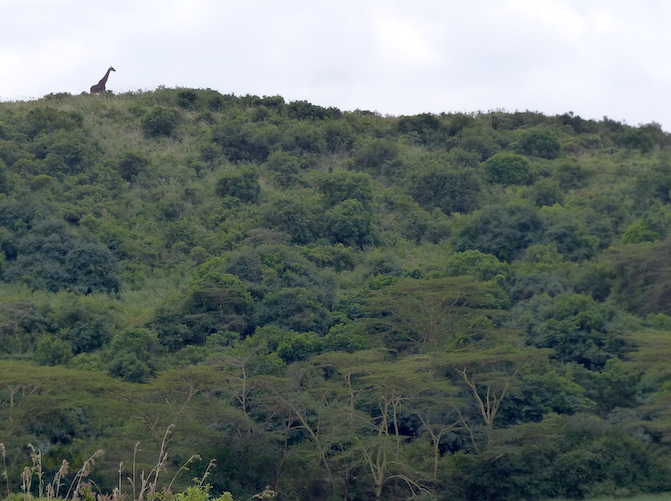
A Giraffe posing nicely.
It is a small park and you can drive most of it in a day.  Yesterday we decided to take a track we have avoided on previous visits in an effort to get up high.  Mostly we keep below 1600 m but there are a dozen or so bird species that only occur above about 2000 m so after a drive to the Momela Lakes we climbed to about 2200 m to a picnic ground.  The road kept going up but some people driving down said it deteriorated badly from that point on.  We possibly would have walked further up but earlier we had seen several buffalo way higher than we thought they would be.  Birding along the road and at the picnic ground produced some lifers - Abyssinian Thrush, Bar-tailed Trogon and Brown Woodland-Warbler along with other forest specialists such as Mountain Buzzard, Kenrick's Starling, Hartlaub's Turaco and Mountain Greenbul.

White-eyed Slaty Flycatcher
Brown-hooded Kingfisher
Otherwise we had a great day in the park.  It was quite busy with family groups enjoying the holiday and safari vehicles with foreign tourists but apart from a few places it was easy to get away from them all.
Giant Fig - according to the signboard you can drive an elephant-sized car through it.
Maio Waterfall above 2000 m.
Ancient Podocarps at Maio Waterfall.
Another highlight was a flock of 22 Maccoa Ducks on Small Momela Lake.  This is a close relative of the Australian Blue-billed Duck and is becoming increasingly rare.  Arusha NP is one of the few places it can be seen in any numbers - formerly in 1000s now not more than 100 at a time.

Maccoa Ducks (stiff, erect tails at the back) with Southern Pochard (at the front).


Sunday, 11 August 2019

Snow and birdng at Kili Golf.

We woke last Saturday to light drizzle and when the skies cleared in the afternoon our mountain had a light dusting of snow.  It lasted through to Sunday.

Zooming in on the snow.
On Thursday (a public holiday) we went with our local birding friends James and Isaac to Kilimanjaro Golf Estate for a few hours of birding.  We met Englishman Alex Rees who lives nearby and he showed us a pond where we found at least six Greater Painted-snipe.  This species is probably not rare but is seldom seen because it usually hides in dense vegetation during the day and is active at night.  Unusually, the females take the dominant role and the males do all the incubating and chick rearing.  We suspect that breeding is about to begin because we saw some aggression between two females.

Sparring female Greater Painted-snipe
Alex had to leave us but we, plus two other late comers spent the next several hours wandering the acacia woodland and wetlands between the fairways.  We saw 74 species in all.  The Painted-snipe, Black-faced Waxbill and African Black Swift were all new for me in Tanzania.  Other highlights included Mourning Collared Dove, Namaqua Dove, Green Sandpiper, Pearl-spotted Owlet, African Hoopoe, Green Wood Hoopoe, Giant Kingfisher, Orange-breasted Bushshrike, Slate-coloured Boubou, Brubru, Black Cuckooshrike, Sombre Greenbul, Violet-backed Starling and Southern Citril.


Greater Painted-snipe (female)

Magpie Shrike


Pearl-spotted Owlet
A young Leopard Tortoise (one of the 'Little Five' along with the Elephant Shrew, the Buffalo Weaver, the Rhinoceros Beetle and the Antlion)
Little Grebe
Green Sandpiper
Long-tailed Fiscal

At home recently we have had much activity at the two birdbaths in front of our house.  Yesterday we had Red-eyed Dove, Speckled Mousebird, Rüppell's Robin-Chat, Streaky Seed-eater, Pale White-eye, Dark-capped Bulbul, Red-backed Mannikin all visiting at the same time.

Arrow-marked Babbler
Baglafecht Weaver
Speckled Mousebird
Red-backed Mannikin
Our African Goshawk pair are still incubating.  Chicks should emerge in another 10 days or so and then we can watch the regular comings and goings as they are fed.  Last night we had a Verreaux's Eagle-Owl calling in the garden but I was not able to find it roosting this morning.

Off to Arusha National Park tomorrow for the day (public holiday for Eid El Haj) and next Saturday we go to a lodge near Lake Manyara for two days as Jenny's birthday treat.

Sunday, 28 July 2019

Birds, a rat and our mountain.

We've had a quiet couple of weeks.  Work and home only.  I had a cold the first week and Jenny has it now (mine was worse).  Last weekend and this we barely ventured out.  Only a trip to the supermarket and a couple of walks down through our local shopping area for fruit and veg.

One shopping highlight is the opening last week of the new Sakina Supermarket.  The old one was a landmark and we still describe where we live in reference to the old location even though it has been closed for quite a while (before we arrived at least).  A while back, shutters went up and then suddenly the new shop was opened.  We popped in to check it out last weekend.  Not fully stocked yet but looking promising for many things we need.

We've had another rat.  It was popping in each evening after lights out but we have been careful not to leave any food out.  Everything is either in cupboards or containers.  I had my lunchbox on the counter with a frozen, home-made bread roll in it to thaw overnight.  The rat made a great attempt to get my roll so next night we set a trap and dispatched it.  So far none have come back.

This is quite tough plastic!

On Monday we came home and the Arrow-marked Babbler family was more than usually agitated about something in the garden.  I went to investigate and found a Spotted Eagle-Owl roosting on a water tank ignoring the Babblers.  It posed for several photos.  I assume it is still around somewhere but haven't seen it again (or heard it during the night).  A common bird but the first one for me.  Hope it stays to eat a few rats.

Spotted Eagle-Owl

I noticed a large nest that had appeared suddenly in one of the Acacias in the garden.  Landlord Paul told me that African Goshawks had nested before in the garden so that's what I assume these are.  I photographed a male near the nest on a couple of occasions but wasn't sure that it was an African Goshawk as it looked a bit small.  I put photos on the Facebook Tanzania birding page and others seem to think it is AG so we'll go with that for now at least.  It will be fun watching the chicks when they hatch in a month or so.

Almost certainly a male African Goshawk but what is it eating? A rat perhaps?

Our mountain has been showing off lately with clear skies.  Hopefully we will see snow on it one day - probably early in the next wet season.  It is about 12 km away in the photos below.

View from our friend Phil's house above Ngaramtoni.


View from Jenny's work at Olkokola (over the cowsheds).


Tuesday, 16 July 2019

Visa progress and Tarangire National Park


Our visa situation has improved.  Jenny has a stamp in her passport saying she can work (as a missionary!) and I have a new tourist visa (good now to October 1st) and my name is on the list of approved work permits.  Hopefully soon I will receive a letter acknowledging my work permit and then we can both get our residence visas.  I went to work every day last week (except Friday) and no longer worry every time a car comes into the grounds.

Huge old Baobabs are features of the park - but where are the new ones?

Part of a large mixed herd of Wildebeest and Zebra heading to water.

The only Secretarybird we saw.
Yellow-throated Sandgrouse - a lifer for me.

Ostrich are commonly seen in small numbers.
On Friday we went to Tarangire NP for two nights.  It is only two hours from home and a relatively easy drive - bitumen except for the last few km to the park entrance.  We arrived about 0930 and drove some tracks for a couple of hours before arriving at the Safari Lodge for lunch.  After lunch we drove more trails then did a big drive to Silale Swamp on Saturday.  The internal roads are often rough with lots of small rocks so we take it much slower than the many safari trucks.  Each afternoon we were back about 1700 for a swim (Jenny) and a beer (me) before dinner at 1900.

One can get quite close to elephants.
Rüppell's Vulture

Three-banded Plover

Yellow-spotted Hyrax
Double-banded Courser

On Saturday's drive we were heading back from Silale Swamp and came across about 6-7 safari trucks stopped together.  We stopped too and managed to see one of seven lions in the long grass before one of the other drivers indicated we had a flat tyre (rear passenger side).  Question: how do you change a tire when there are seven lions 100 m away in waist-high grass? Answer: as quickly as possible.  We drove a bit further away and one of the safari truck drivers very kindly helped so it didn't take long but we were all nervous and asked the other people to watch the lions carefully.

Giraffe were not often seen.

Von der Decken's Hornbill.  These two stole snacks from people having sundowners.

Unstriped Ground Squirrel at their burrow near our tent.
Zebra were everywhere.
Tarangire Safari Lodge is seriously pleasant.  We had a cosy tent with Dikdiks, Waterbuck and Ground Squirrels roaming around.  Each night we could hear a lion roaring not too far away.  The outdoor sundowner area has probably the best view of any lodge we've been to - over the Tarangire River with Elephant, Giraffe, Zebra etc. coming and going constantly.  Great food and friendly attentive staff - what more could you want?  This visit it was at near capacity but everything ran smoothly at meal times.  Our spare tire was not as inflated as it might have been so we asked for air on Sunday morning and the lodge mechanic promptly turned up with a compressor.  Then we looked at the punctured tire and found a ridiculously small screw embedded.  All the km of stony roads and we were brought undone by a screw!  The mechanic fixed our tire as well (no charge) so we were soon on our way with no need to find a tire repair place on the way home.


Red-and-yellow Barbet on a termite mound.

Spotted Thick-knee
We saw 118 bird species and many mammals.  Best birds were Yellow-throated Sandgrouse (lifer), Ostrich, Yellow-necked Spurfowl, White-bellied Bustard, Namaqua Dove, Saddle-billed Stork, Glossy Ibis, Secretarybird, Rüppell's Vulture, Martial Eagle, Pearl-spotted Owlet, African Hoopoe, D'Arnaud's Barbet, Bearded Woodpecker, Pygmy Falcon, Banded Martin, Northern Pied Babbler, Silverbird, Chestnut Swallow, White-headed Buffalo Weaver, Red-headed Weaver and Green-winged Pytilia.  Mammals included many Elephants, Zebra, Wildebeest and smaller numbers of Buffalo, Giraffe, Impala, Eland and Gazelle.  We also saw several Mongoose, Squirrel, Rock Hyrax, a Lion and a road-killed small, spotty cat (Genet, Serval or similar).  Still no Leopard!

White-headed Buffalo Weaver

Back to work tomorrow - no plans for more safaris until late September when friends are coming from Warrnambool and we hope to go with them to Lake Natron for a few days.

Elephants wading in Silale Swamp.