Sunday, 3 November 2019

Work stuff, birding the Maasai Steppes and home.

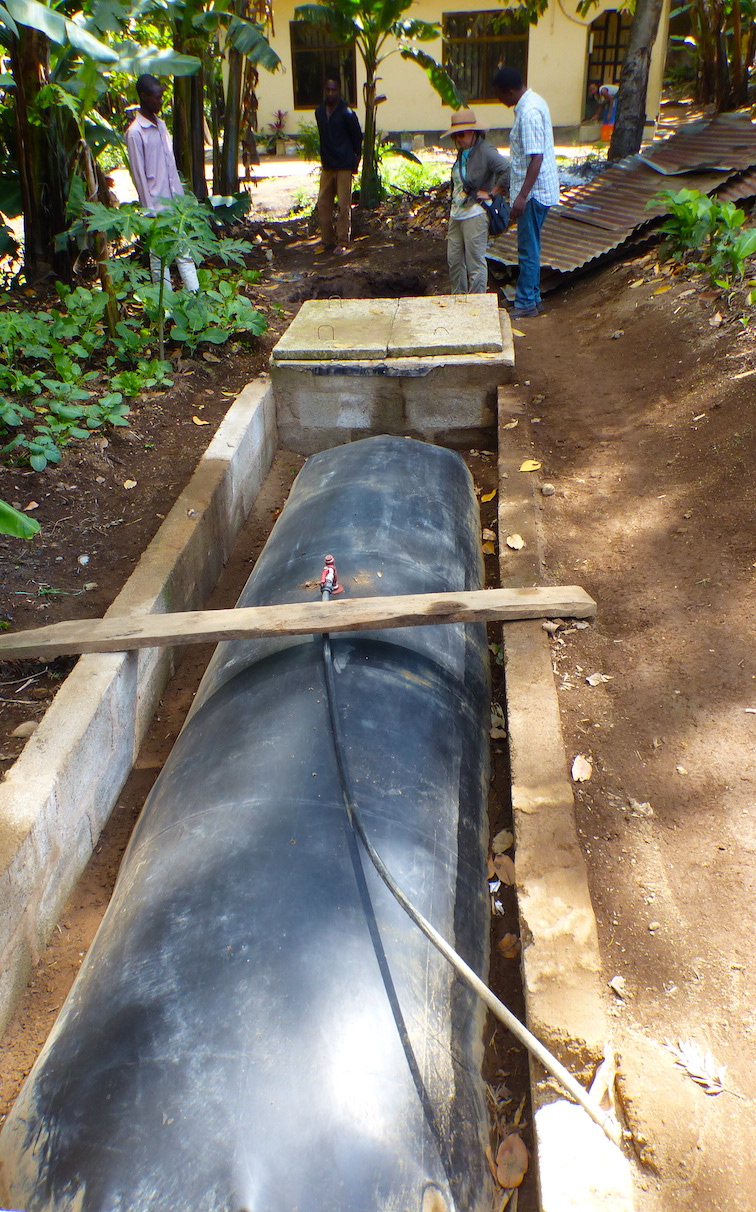
Herry, a local Biogass consultant and Harold Msanya, my office mate at ECHO,
using a filled portable biogas bag to cook rice.
I haven't said a lot about work for a while so this blog will be mostly related to my day job.  I have spent a lot of my time so far writing project funding applications.  These vary from a few thousand dollars to hundreds of thousands and from a few months to four years duration.  So far I've had one hit and three misses.  The hit was a $10,000 grant from the Australian Government - a Community Grants Scheme which is administered by Australian Volunteers for International Development.  In this case my colleague Harold Msanya wrote the application with some advice and minor editing from me.  I will get him to write all proposals from now on!  Coincidentally, Jenny's organisation also received one of these grants (and she did all the work).  Tanzania was the only country which received more than one grant and ours were the only successful grant applications in Tanzania.

It is disappointing to put in weeks of work to prepare a proposal for submission and then have it miss at the first cut but the schemes are heavily subscribed and the odds of success are small.  All we can do is keep trying.  I have a small application nearly ready to submit on Tuesday and more concepts in the pipeline for the future.

Methane bubbling away nicely
Output from a digester heading straight into the fruit and veggie garden.
No labour required.  Cow manure straight into the digester.
A small biogas digester for a household.
A typical kitchen burner - so much cleaner and healthier than using charcoal.

We have been busy with two biogas projects recently.  Biogas is methane produced in a digester chamber into which is fed animal (inc. human) manure, food scraps, garden clippings etc.  The slurry that emerges is excellent fertiliser.  The methane produced is used for domestic cooking mainly but can also be used for lighting, heating and egg incubating.  We are evaluating portable gas bags that can be filled with excess methane from a digester and then sold to neighbours for use in their kitchens.  This will hopefully replace some of the charcoal that is widely used and is unsustainable produced from forests.  The technology works well but we are still unsure of the economics.  As well as evaluating the portable bags we have run a 10-day training program with a group of young entrepreneurs wishing to be biogas digester installers.


ECHO colleague Charles Bonaventure (Bonny) is a real people person.
Here spreading the word about nutritious leafy greens.
Isabel Galeano and Herry with keen biogas entrepreneurs in training.
ECHO is active in running local and international conferences and later this month we are hosting the East Africa Symposium on Best Practices of Improving Nutrition and Sustainable Agriculture in Highland Areas.  It will be held over three days in Kigali, the capital of Rwanda and I've been asked to attend and give a talk on the potential of incorporating endophytes into everyday crop species.  I've never been to Rwanda before so it should be fun.  Apparently we are driving there and back so it will be interesting to see lots of new country in Tanzania as well.  It is a looong way from here though.

Recently Jenny and I attended an ECHO weekend workshop on invasive weeds recently.  The worst weed in the Arusha district is Parthenium hysterophorus (Carrot weed).  It is an annual daisy bush from central America and has invaded many tropical and sub-tropical countries around the world.  It is resistant to common herbicides, produces foliage which is toxic to livestock and highly irritating to humans who contact it.  It produces chemicals from its roots to suppress other plant species nearby and is a prolific seeder.  Seed can remain viable in the soil for at least 20 years.  If you were designing  the perfect weed it would have these characteristics.


Parthenium taking over a roadside in Hawaii.  Could easily be Arusha. (Photo from Wikipedia)

Biological control is the only solution once it is established but it is easy to pull out when it is first noticed in a new location (as long as you are wearing rubber gloves).  The Tanzanian government has released some biological control organisms and is evaluating others but they are not having a huge impact yet.  ECHO is keen to educate farmers and others outside its current range to identify and remove plants before they can become established.  It was great to see many farmers from outside Arusha along with government research and extension staff at the workshop.  Disappointing that many of the NGOs we invited did not send staff however.

We have had a visit from Zoe, the National Program Manager for AVID and our regional director Colin who is based in Sri Lanka.  Time permitted them to only visit a couple of workplaces and Jenny's was one on Friday.  I tagged along to take some photos as ECHO is just down the road.  On Saturday all Arusha AVID volunteers joined Zoe, Colin and our in-country management team of Musa and Lizzie for a meeting and a sumptuous lunch at a nice big hotel in town.  It was fascinating to hear all the stories, successes, frustrations etc from our colleagues and to get Zoe's and Colin's input on the program from a management perspective.

Jenny with Zoe - AVID National Program Manager.

Jenny's boss, Father Pat, making a point with Colin - AVID Regional Director.
On Wednesday at work we had a visit from 5 government officials from the Ministry of Community Development, Health and Children.  They enquired into all aspects of ECHO and were particularly interested in the documents of the non-Tanzanian staff.  We hopefully satisfied them that we were all legitimate.  It was all rather unpleasant.

Birding has been relatively quiet of late but there have been some highlights.  I went out with English friend Alex and two Tanzanian friends James and Abdul to the Maasai Steppe region south east of Arusha.  We birded some acacia woodland and then wandered around the shore of Shambarai Swamp for over 80 species.  The only new one for me was Tsavo Sunbird but a few others were new for my Tanzania list.  Lots of waders and other waterbirds.  Many bush birds were also seen coming in to drink.

Mourning Collared Dove
Grey-headed Silverbill
Yellow-billed Stork
Fork-tailed Drongo
African Spoonbill
Cut-throat Finch
There is a Weaver colony at Jenny's workplace front gate and I finally stopped to check them out a few days ago.  Lifer!  Speke's Weaver.  Not uncommon in these parts apparently but I hadn't bumped into them before.  We have had tantalising views of a skulking, greyish, thrush-sized bird along the laneway outside our gate.  I think it is probably a Common Nightingale recently arrived from Europe.  A mystery for now!

Speke's Weaver
This morning I heard loud wingbeats wooshing over the house and I went out to try to photograph the expected Silvery-cheeked Hornbill.  It turned out to be a Trumpeter Hornbill.  This species is found along the coast and in forests further east than here so was a bit of a surprise.  Landlord Paul says he has not seen one in the area before.  I've only seen them once before - in the hills behind Dar es Salaam in 2011.

Trumpeter Hornbill
Time for a bird tally update:

Lifelist: 2313
Tanzania list: 587
Lifers this trip: 29
Total this trip: 371


Sunday, 13 October 2019

A visitor and a trip to Lake Manyara NP

Lesser Flamingos near and far.

Our friend Rhona arrived last weekend from Scotland.  We last saw her in Bukoba in 2011 where she was working at the Katoke Teacher Training College as a VSO volunteer.  Now she is about to commence a PhD in teaching methodologies and is heading back to Bukoba for 6 months.  First though she is dusting off her Swahili with a two week course in Usa River.  She stayed with us last weekend and again this weekend.  It was great to catch up.

Rhona and Jenny enjoying a picnic lunch at Lake Manyara

On the boardwalk over the hot springs.
Yesterday we all headed off to Lake Manyara NP and Jenny and I were delighted to find our residence visas were honoured and we got in for half price.  The rainy season arrived on October 1st and it has rained most days since - often heavily.  So the park this time was damp and green compared to the dry dusty condition back in August.  It was also much quieter with fewer safari trucks holding us up.  Elephants, on the other hand, were a nuisance. We encountered our first group about one minute inside the gate and had to wait quite a while until they cleared off the road.  Two other groups were less obliging and we turned around.  There's no arguing with four large bull elephants when you are in a small RAV 4.

These four bulls were not shifting and we had to turn around.
In August we had extra time in the park as we were staying in a nearby lodge.  This time we were a bit rushed and saw fewer bird species (83 instead compared to 104 in August).  We drove the 30 km to the Hot Pool picnic site in around 2½ hours with stops for elephants, birds, other mammals etc.  After lunch we wandered along the board walk counting Grey Herons (350), Yellow-billed Storks (70) and noting the vast flocks of Lesser Flamingos that stretched along the whole lake shoreline.

Lesser Masked Weaver
Peregrine Falcon (probably just arrived from Siberia)
Little Bee-eater
Juvenile Palm-nut Vulture (trying to consume a small Leopard Tortoise)
Silvery-cheeked Hornbill
Going back was a bit more leisurely but we reached the hippo pool in good time.  Just as we arrived the heavens opened and we thought that was it for the day but it stopped as suddenly as it started and we drove the swamp circuit track stopping often to observe all manner of ducks, waders, herons etc.  There was only one hippo in the pool today and it was enjoying being groomed by a Jacana.

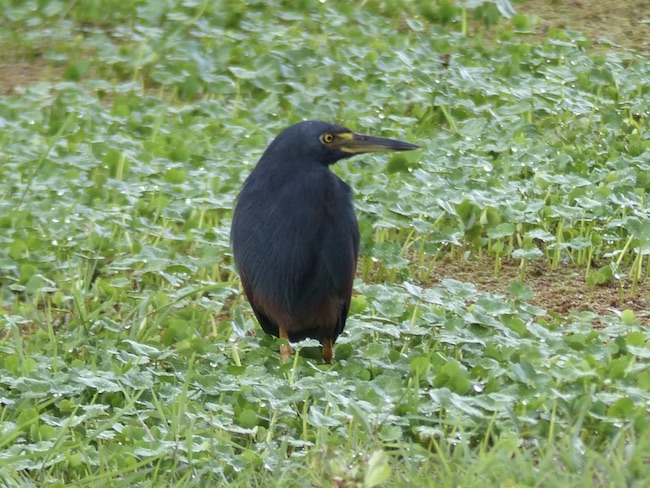
Rufous-bellied Heron
Red-billed Teal

Black Crake
Common Sandpiper
Hottentot Teal
African Jacana grooming the Hippopotamus

We left the park later than I would have liked and had a rather unpleasant drive home in often heavy rain and decreasing light.  Few drivers put on their lights in Tanzania until it is absolutely dark.  I was even flashed by a police car at one point - telling me my lights were on.  Overtaking slow trucks is tricky when you can't see cars coming towards you in the gloom with no lights.  We managed to get home OK though and today we took Rhona back to the language training place in Usa River after a lovely lunch in a fancy safari lodge.

Some obliging Impala - normally they turn and walk away.


Tuesday, 1 October 2019

Rain!

For the first time in about four months we are listening to steady rain on the roof.

The short rainy season typically starts in late October and extends into December.  The long rainy season typically runs from March to May.

So only October 1st and here it is?  Perhaps!

Monthly rain totals - average from 1988-2019 at Olkokola, Arusha

We had a huge dust storm blow through Arusha today and no-one had experienced anything like it here before.  The rain followed close behind.


Video of dust storm engulfing Arusha

The rain-bearing cloud band moving through Arusha from 

the south-east this afternoon.

Saturday, 28 September 2019

Lake Natron safari

Lake Natron
Our friends Martin and Kaz Dunstan from Warrnambool are in Tanzania for a month working at the Bandari Project (www.thebandariproject.com) in Mto wa Mbu, 2 hours west of Arusha.  They had the idea of a 4-day safari to Lake Natron near the Kenya border and we went with them in the capable hands of our friend Stanley Mbogo of Zorilla Safaris (www.zorillasafaris.com).

Lake Natron is about 50 km north-south and 15 km east-west.  It is very shallow (mostly less than 3 m) and is fed mainly from rivers flowing in from Kenya.  The high evaporation rates and the underlying rock types mean that the water is highly caustic and alkaline.  Perfect for flamingos and both African species are there in abundance as seen in many a wildlife documentary.  The fresh and brackish water around the edges of the lake teem with many species of waterbirds.  We saw large flocks of migratory Little Stints and many other waders.

Kori Bustard
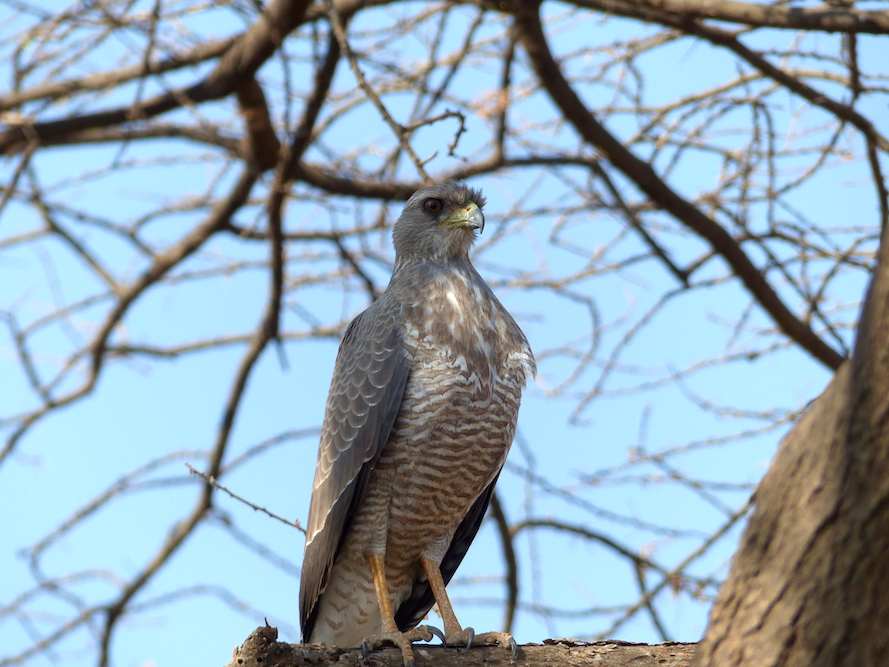
Eastern Chanting-Goshawk
Stanley picked up Jenny and me in Arusha at 0600 then Martin and Kaz in Mto wa Mbu and we were off the tarmac by 0900 and onto 5-6 hours of gravel for the drive north to our camp.  The road runs along the western rim of the Rift Valley with the landscape growing progressively drier and more rugged as we headed north.  A highlight along the way was a pair of male giraffe fighting.  Mostly they walked together, keeping close eye contact, but periodically they would thump each other with their necks.  This can lead to concussion and broken limbs.  I shot some video of the walking but didn't capture any of the thumping.

Zebra usually just turn and show their bums so this was a nice shot.
Soon after the small town of Engaruka we got our first glimpse of the Ol Doinyo Lengai, Tanzania's only active volcano, 3188 m high.  Mounts Meru and Kilimanjaro are neither active or extinct but are considered dormant.  Ol Doinyo Lengai's most recent eruption was in 2013.

Ol Doinyo Lengai (Mountain of God).
As we got closer to the mountain the road traversed large lava flows and the vegetation thinned out to small tussock grasses as shrubs and trees struggle to get their roots into the hard lava.  We reached our camp (www.worldviewcampsite.com) and were settled into a nice banda with 4 double rooms by mid-afternoon.  We recovered from the bumpy drive while relaxing on the verandah overlooking the valley with Lake Natron to our left and the volcano to our right.

View from World View Camp
Our banda for three nights.
On Sunday morning we had a pre-breakfast visit to the lake for giraffes, zebras, flamingos and many other birds.  On the way back to the car we had to run the gauntlet of Maasai women selling their beaded artwork.  We also visited a place where some early humans had walked across a lava field leaving 120,000 year old footprints.

Greater and Lesser Flamingos in the shallows.
Stanley, Jenny, Kaz and local guide Laina.
The evolution of the human foot over 120,000 years.
Running the gauntlet of trinket sellers.

In the afternoon we hiked up the rocky gorge behind the camp to a waterfall and swimming hole.  It was a bit treacherous and involved several stream crossings with water to waist level.  Not sure if this would be possible in the wet season.  Spectacular though with the permanent stream, towering cliffs and glimpses of a pair of Verreaux's Eagles soaring overhead.

The waterfall above World View Camp.
Blending in with the locals.

Martin headed off at 11pm to climb the volcano ...

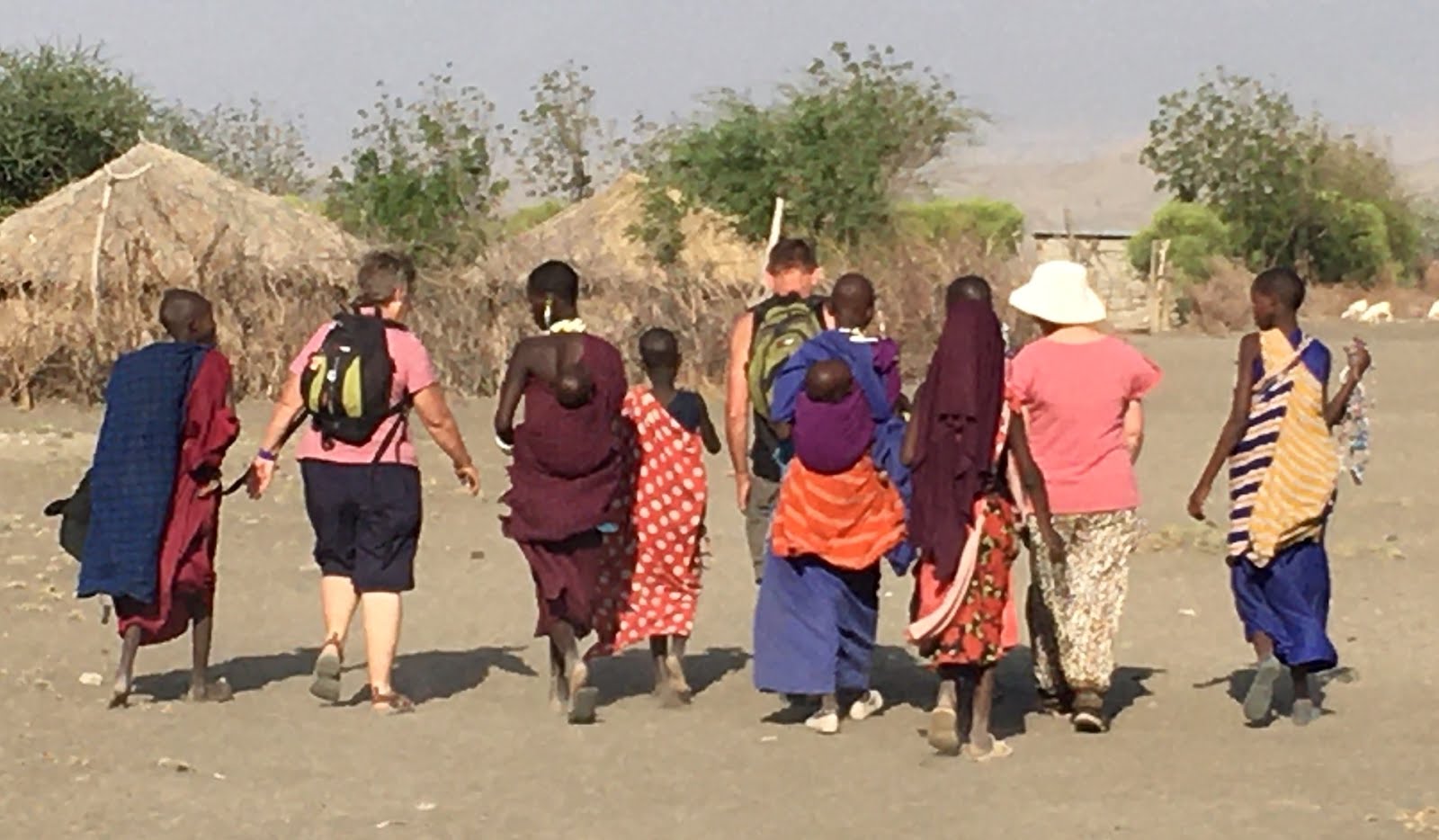
Monday morning Jenny and Kaz headed off down the hill to the Maasai village below us for a women's cultural performance with traditional dancing and handicrafts for purchase while I birded and photographed around the camp.  Martin returned around lunchtime and was totally exhausted.  He and Kaz had climbed Kilimanjaro in 2016 but this was harder.  It took the same time going up as coming down.  Late in the afternoon we drove to a different part of the lake to watch the sun go down.  While the others explored the fresh water streams pooling near the lake I wandered through the nearby Acacia woodland with Stanley and saw a few nice birds.

Beautiful Sunbird
Laughing Doves making more Laughing Doves.
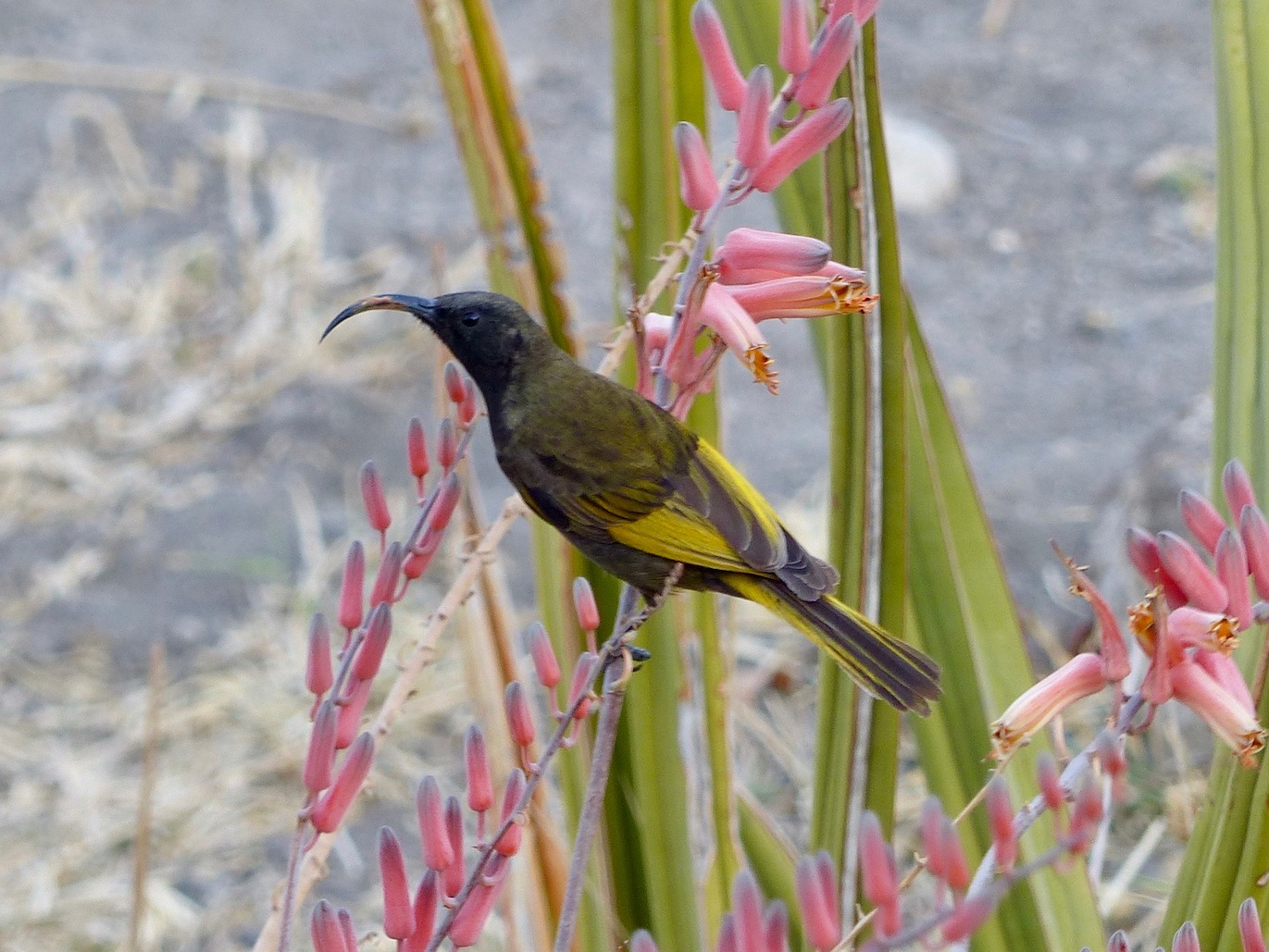
Golden-winged Sunbird
White-browed Sparrow-Weaver
The locals collect slabs of rock salt from the lake and sell it to passers-by for use with livestock nutrition.  Martin, being a livestock extension officer picked up a slab from a roadside pile for a taste test and replaced the slab.  A minute later a dog came and pissed on the slab.  Good one Martin!

On the way home on Tuesday we stopped at the Engaruka ruins and had a guided tour of old (?) stone houses and irrigation systems.  The information we were given was very confusing.  Were the people who built these structures living there 10,000 years ago or 500 years ago?  Were they a tribe that was pushed out by the incoming Maasai or were they German settlers?  It was a nice walk no matter what the truth of the situation is!

Remains of a stone house.  There would have been a central pole and an animal hide roof.
Jenny scaring away children by doing maths at them.
Worldview camp is not a luxury lodge - there are more expensive places to stay nearby - but it has great staff, clean rooms, power and hot water, green grass, shady trees and spectacular views. The food was basic but plentiful and tasty.  You can be guaranteed that most of the money will stay in the local community - which is not always the case.  We plan to go back after Christmas when the region has had some good rain.

Royal Poinciana (Delonix regia) - a native of Madagascar - at Engaruka.

Sunday, 15 September 2019

An African twitch

I've made efforts to see some difficult African birds but this has always involved going to a place where the species is know to be present normally - e.g. Green-breasted Pitta in Kibale NP in Uganda, Protea Canary at Mountain Mist near Capetown, South Africa and the Rockrunner in the Waterberg Plateau, Namibia.

On Tuesday there was a report with photos from a Safari Guide and birder on Facebook of a Rosy Starling in the village of Nanja about 30km west of Arusha.  Our Attraction Birding Club friends went and saw it on Wednesday and Jenny and I, with three of the chaps, went on Saturday morning.  We pulled off the highway where the town dump is and within about 30 seconds, saw the bird foraging on the ground with Red-billed Buffalo Weavers and Superb Starlings in the strewn rubbish.  It soon flew across the highway to the town and posed nicely in a tree while singing its heart out.


Rosy Starling is naturally found in Asia, parts of the Middle East and extending into southern Europe. It has been recorded twice in Ethiopia, once in Kenya and once in South Africa.

Having twitched the Starling we then went to explore the nearby Eluanata Dam which pulls in many waterbirds.  We had planned to visit later in October when the landscape is at its driest.  On this visit there were some 60 species at the dam and in surrounding bush.  Highlights were Hottentot Teal, Great Crested Grebe and a Cinnamon-breasted Bunting.


Capped Wheatear

Cinnamon-breasted Bunting
Kenya Sparrow

The final highlight was a pair of melanistic Gabar Goshawks seen well on the outskirts of Nanja.

A melanistic Gabar Goshawk.

A week of work then off to Lake Natron for four days next Saturday.